Climate action costs money. Specifically, India's climate commitments—renewable energy targets, emission reduction pledges, adaptation infrastructure, carbon capture research—require sustained, substantial, and strategically allocated public expenditure over decades. The Union Budget 2026-27 allocates approximately ₹55,000-60,000 crore across various climate-related programmes, clean energy incentives, and environmental management schemes. This number, while large in absolute terms, must be evaluated against the scale of the challenge: India is the world's third-largest greenhouse gas emitter (after China and the United States), the most climate-vulnerable major economy (due to its geographic exposure to monsoon variability, extreme heat events, coastal flooding, and Himalayan glacial melt), and a developing country whose 1.4 billion citizens have a legitimate demand for continued economic growth—growth that has historically been powered by fossil fuel combustion. India's climate budget is, fundamentally, an attempt to navigate the most consequential economic transition in human history: decarbonizing a continental-scale economy while simultaneously lifting hundreds of millions of people out of poverty.
The framing matters enormously. In international climate negotiations—the COPs, the Paris Agreement reviews, the UNFCCC sessions—India is frequently positioned as both a climate villain (fourth-largest total CO2 emitter, massive coal consumption) and a climate victim (disproportionately affected by rising temperatures, erratic monsoons, sea-level rise). Both characterizations contain truth; neither captures the full picture. India's per capita emissions (approximately 1.9 tonnes of CO2 per year) are roughly one-eighth of American per capita emissions (approximately 14.5 tonnes) and one-third of Chinese per capita emissions (approximately 7.7 tonnes). The cumulative historical emissions argument—that developed countries industrialized over 200 years of unrestricted fossil fuel use and bear proportionally greater responsibility for the current atmospheric CO2 concentration—is not merely a diplomatic talking point; it is a factually accurate description of the physics of climate change. Carbon dioxide persists in the atmosphere for hundreds of years. The warming we experience today is primarily caused by emissions from the Industrial Revolution onward—a period during which India's contribution was negligible.
Where India's Climate Budget Actually Goes

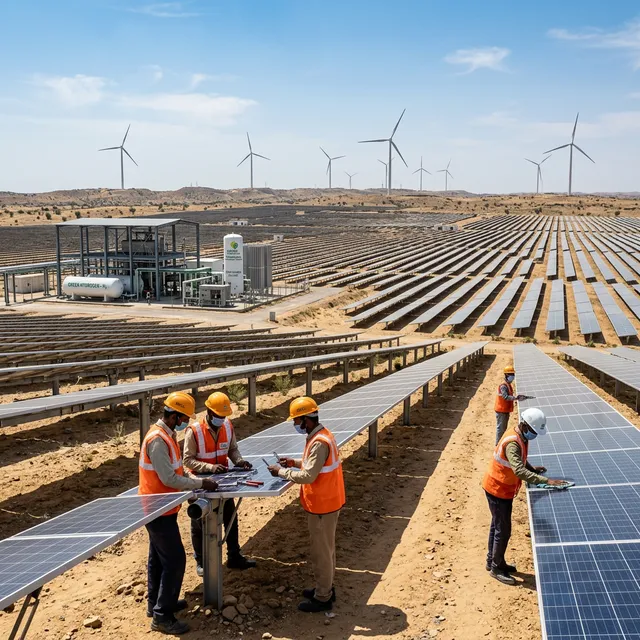
Renewable Energy Deployment: The single largest climate-related expenditure category is the government's support for renewable energy deployment. India has committed to achieving 500 GW of non-fossil fuel electricity generation capacity by 2030—an extraordinarily ambitious target that would require roughly tripling current renewable capacity in five years. The budgetary support for this target flows through multiple channels: Production Linked Incentive (PLI) schemes for solar module manufacturing (approximately ₹19,500 crore allocated over multiple years to build domestic solar panel production capacity and reduce dependence on Chinese imports that currently supply over 80% of India's solar modules); viability gap funding for solar and wind projects in regions with lower commercial viability; transmission infrastructure investment to connect renewable generation sites (often in remote, windy, or sun-rich locations) to urban consumption centres; and grid-scale battery storage deployment to address the fundamental intermittency challenge of solar and wind power (the sun doesn't shine at night; the wind doesn't blow consistently).
The National Green Hydrogen Mission: India's most strategically ambitious climate programme is the National Green Hydrogen Mission, launched with an outlay of ₹19,744 crore and targeting 5 million tonnes of annual green hydrogen production by 2030. Green hydrogen—produced by splitting water molecules using electricity from renewable sources—is potentially transformative for decarbonizing industrial sectors that cannot be easily electrified: steel manufacturing (which currently uses coal-based blast furnaces), cement production (which generates process emissions from limestone calcination regardless of the energy source), long-haul transportation (where battery weight makes electrification impractical for heavy trucks and ships), and ammonia/fertilizer production (which currently uses natural gas as both feedstock and energy source). If India achieves its green hydrogen production target at competitive costs—below $2 per kilogram, approaching cost parity with grey hydrogen produced from natural gas—it would simultaneously reduce India's industrial emissions, reduce dependence on imported natural gas, and position India as a global exporter of green hydrogen and green hydrogen-derived products (green ammonia, green steel, green methanol) to decarbonizing economies in Europe, Japan, and South Korea.
Carbon Capture, Utilization, and Storage (CCUS): The budget includes initial allocations for carbon capture technology research and pilot projects—the most scientifically complex and economically uncertain component of India's climate strategy. CCUS involves capturing CO2 from the exhaust of power plants and industrial facilities, transporting it (via pipeline or ship), and permanently storing it in deep geological formations (depleted oil and gas reservoirs, deep saline aquifers). The technology exists and works at pilot scale; the challenge is economics and scale. Current CCUS costs range from $60-120 per tonne of CO2 captured—far above the implicit or explicit carbon prices in most jurisdictions, making CCUS commercially unviable without substantial government support. India's geological potential for CO2 storage—in the Deccan Trap basalt formations, the Krishna-Godavari basin, and depleted oil fields in Gujarat and Rajasthan—is estimated at several billion tonnes, theoretically sufficient for decades of industrial emission storage. The practical challenges—site characterization, injection well drilling, long-term monitoring, and regulatory frameworks for subsurface CO2 storage liability—remain largely unexplored in the Indian context.
Adaptation: The Spending That Actually Saves Lives
India's climate adaptation spending—investment in infrastructure and systems that help communities survive and function under changing climatic conditions—receives less international attention than mitigation (emission reduction) spending but is arguably more immediately consequential for Indian lives. Climate adaptation in India means: building flood-resilient urban drainage systems in cities that experience increasingly intense monsoon rainfall; constructing cyclone-resistant housing in coastal Odisha, West Bengal, and Gujarat; developing drought-resistant crop varieties and water-efficient irrigation systems for Rajasthan, Maharashtra, and Karnataka's rain-dependent agricultural regions; deploying early warning systems for extreme weather events; and strengthening the healthcare system's capacity to respond to heat-related illness during increasingly severe summer heat waves.
The National Adaptation Fund for Climate Change, the Prime Minister's Crop Insurance Scheme (PM Fasal Bima Yojana), the Jal Jeevan Mission (rural piped water supply), and the Atal Mission for Rejuvenation and Urban Transformation (AMRUT) for urban water supply and sewerage—while not exclusively climate programmes—all incorporate significant climate adaptation components. The challenge is that adaptation spending is inherently dispersed, locally specific, and politically unglamorous: building a flood-resistant drainage system in Patna does not generate international climate conference headlines, but it directly prevents the drowning deaths and property destruction that Bihar's recurring floods produce.
The Coal Paradox: India's Most Uncomfortable Climate Truth
India mined approximately 900 million tonnes of coal in 2025-26 and generated approximately 70% of its electricity from coal-fired thermal power plants. Coal is not a historical relic in India's energy system; it is its foundation. Roughly 4 million workers are directly employed in coal mining, and several Indian states—Jharkhand, Chhattisgarh, Odisha, Madhya Pradesh, West Bengal—have regional economies substantially dependent on coal extraction, transportation, and combustion. India's coal production is increasing, not decreasing—the government has explicitly stated that India will continue to use coal as a baseload power source while simultaneously expanding renewable capacity.
This "additive" strategy—adding renewables to the energy mix without retiring coal capacity—is the most politically pragmatic and environmentally insufficient approach available. It is the approach that a democracy representing 1.4 billion citizens at vastly different income levels, with legitimate energy access demands that cannot be met by intermittent renewables alone, and facing imminent elections in which coal worker livelihoods are a potent political variable, can realistically pursue. The international climate community, which advocates rapid coal phase-out, frequently underestimates the political economy constraints facing a developing-country democracy. Telling Jharkhand's coal mining communities—many from Scheduled Tribe and Other Backward Class backgrounds, already among India's most economically marginalized populations—that their livelihoods must be sacrificed for a climate crisis they did not cause is not merely politically difficult; it is ethically complex in ways that wealthy-country climate advocacy rarely acknowledges.
Frequently Asked Questions (FAQs)
Is India doing enough on climate change?
"Enough" is a normatively loaded term that depends entirely on the baseline against which you measure. Relative to its Paris Agreement commitments (reducing emission intensity of GDP by 45% from 2005 levels by 2030, achieving 50% cumulative electricity capacity from non-fossil sources by 2030, and achieving net-zero emissions by 2070), India is broadly on track—particularly on renewable energy deployment, where installed solar capacity has grown from 2.6 GW in 2014 to over 80 GW in 2026. Relative to what climate science says is necessary to limit warming to 1.5°C, India's trajectory—continued coal expansion, rising absolute emissions, and a 2070 net-zero target that is 20 years later than the IPCC's recommended global timeline—is insufficient. But applying the 1.5°C benchmark to India alone, without accounting for the vastly larger cumulative and per capita emissions of the United States, Europe, and China, represents a distribution of responsibility that India (and most developing countries) correctly identifies as inequitable.
What is green hydrogen, and why is India investing so heavily in it?
Green hydrogen is hydrogen gas produced by electrolysis—splitting water molecules (H2O) into hydrogen (H2) and oxygen (O2) using electricity from renewable sources (solar or wind). The "green" designation distinguishes it from "grey" hydrogen (produced from natural gas, releasing CO2) and "blue" hydrogen (produced from natural gas with carbon capture). Green hydrogen matters because it can decarbonize industrial processes that electricity alone cannot: steel production, cement manufacturing, fertilizer synthesis, long-distance shipping fuel, and energy storage for grid balancing. India's investment in green hydrogen is driven by three strategic calculations: climate commitment (green hydrogen can reduce India's industrial emissions by 20-30%), energy security (domestically produced green hydrogen reduces dependence on imported natural gas and coal), and export opportunity (Europe, Japan, and South Korea will need massive amounts of green hydrogen to meet their decarbonization targets, and India's abundant solar resources give it a potential competitive advantage as a low-cost green hydrogen producer).
How does climate change directly affect ordinary Indians in 2026?
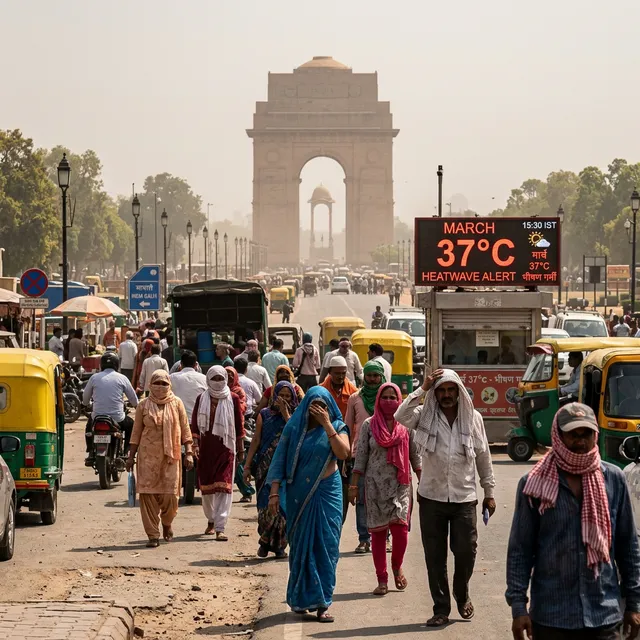
The effects are already visible and measurable. Extreme heat events: Indian summers are measurably hotter than a decade ago—peak temperatures exceeding 45°C in north and central India are more frequent, more sustained, and more geographically widespread, causing heat stroke deaths, reduced agricultural labour productivity, and increased electricity demand for cooling. Monsoon variability: the Indian monsoon is not weakening, but it is becoming more erratic—shorter periods of more intense rainfall, longer dry spells within the monsoon season, and increased geographic disparity (some regions flood while adjacent regions experience drought). Agricultural impact: rising temperatures, erratic rainfall, and groundwater depletion are reducing yields of wheat, rice, and pulses in vulnerable regions, directly affecting farmer incomes and food prices. Coastal vulnerability: sea-level rise threatens communities in low-lying coastal areas of Kerala, West Bengal, Mumbai, and Chennai. Himalayan glacial melt creates upstream flooding risks for major north Indian river systems. These are not future projections; they are documented, observed, currently occurring impacts.

Comments (0)
Be the first to share your thoughts on this article.