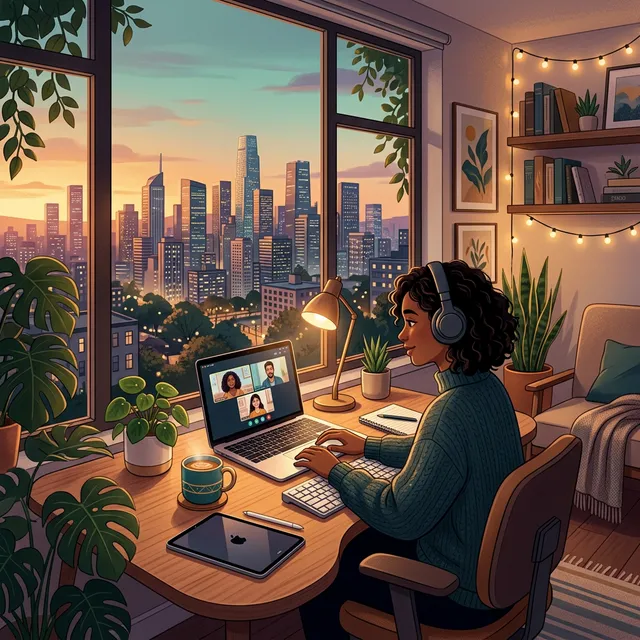
The pandemic-era experiment is over. The frantic improvisation of 2020—laptops on kitchen tables, Zoom calls interrupted by children, the desperate pretence that working from a bedroom corner was equivalent to working from an office—has been replaced by something more deliberate, more sustainable, and more honest about both the genuine advantages and the real limitations of remote work. The question is no longer "can people work remotely?" (they obviously can) or "should companies allow remote work?" (the labour market has answered this decisively: companies that refuse flexibility lose talent to companies that provide it). The question in 2026 is more specific and more interesting: how do you build a home working environment that sustains high-quality professional output over years, not weeks—without sacrificing your physical health, your mental wellbeing, or the spatial sanity of whoever else lives in your home?
I have worked from home for four years. Not the cafés-and-coworking-spaces version of "working from home" that digital nomad culture romanticises, but the actual, unglamorous reality of sitting in the same room, at the same desk, in the same house, producing professional work for the same employer, day after day, for 200+ working days per year. The first two years were marked by every mistake in the Work From Home handbook: ergonomic disasters that produced chronic back pain, boundary failures that blurred work and personal life into an undifferentiated grey mass, and equipment choices that prioritised aesthetics over function. The second two years have been an iterative correction of those mistakes, and the result is a working environment that is genuinely superior to the open-plan office I left—not in every dimension, but in the dimensions that matter most: deep focus capability, physical comfort, and the ability to structure the working day around energy levels rather than arbitrary schedules.
The Physical Space: What Actually Matters

The Chair: This is the single purchase decision that will most significantly affect your long-term physical wellbeing as a remote worker. You will sit in this chair for 6-10 hours per day, 200+ days per year. The compound effect of poor sitting posture over this duration is not theoretical—it is clinically documented: lumbar disc compression, scapular instability, hip flexor shortening, cervical strain. A quality ergonomic chair—one with adjustable lumbar support, seat depth adjustment, armrest height and width adjustment, and a recline mechanism with tension control—costs ₹25,000-70,000 for a good Indian brand (Featherlite, Godrej Interio, Green Soul) or ₹40,000-120,000 for international options (Herman Miller, Steelcase, Secretlab). This expenditure is significant and non-negotiable. No other home office investment has a comparable impact on your health, comfort, and sustained productivity. Every rupee saved on the chair is spent later on physiotherapy.
The Desk: The desk matters less than the chair in terms of ergonomic impact, but two features are essential: sufficient depth (at least 60cm, ideally 70cm, to place the monitor at arm's length) and the correct height for your body (the desk surface should be at the height where your forearms rest parallel to the floor with your shoulders relaxed and your elbows at roughly 90 degrees). A sit-stand desk—adjustable between sitting and standing heights via electric or manual mechanism—is a worthwhile investment (₹15,000-40,000 for electric models) not because standing is inherently healthier than sitting (the evidence is more nuanced than the "sitting is the new smoking" marketing suggests), but because the ability to change position throughout the day—alternating between sitting and standing in 45-90 minute cycles—reduces the static loading on any single set of muscles and joints. The movement itself is the benefit, not the standing.
Lighting: Natural light is the single most important environmental factor for sustained cognitive performance and circadian health. If you have any choice about which room becomes your office, choose the room with the largest windows. If your available space has limited natural light, invest in a daylight-temperature desk lamp (5000-6500K colour temperature) that provides bright, blue-enriched light during working hours. Warm, dim lighting is comfortable for evening relaxation and catastrophic for afternoon productivity—if your office lighting makes you feel sleepy at 2 PM, the colour temperature of your lights is too warm, not the post-lunch blood sugar dip you're blaming.
The Digital Environment: Beyond Hardware
Separation of Work and Personal Digital Life: If you use the same laptop, same browser, same desktop for work and personal activity, you have no boundary between work and life—they coexist in the same digital space, and the cognitive load of context-switching between email threads and YouTube recommendations is constant and exhausting. The solution is either a separate device for work (ideal but expensive) or rigorous digital separation on a single device: separate browser profiles (one for work, one for personal, never mixed), separate user accounts if your OS supports it, and notification management that ensures work notifications are silenced outside working hours and personal notifications are silenced during them.
Communication Discipline: The most insidious productivity killer in remote work is not distraction by household activities (these are manageable)—it is continuous partial attention to messaging platforms. The sensation of being perpetually "available" on Slack, Teams, or WhatsApp creates a background anxiety that fragments concentration: you are never fully focused on your task because a portion of your attention is monitoring the chat window for messages that might require response. The research is unambiguous: every context switch (checking a message and returning to your task) costs 15-25 minutes of deep focus recovery time. Five message checks per hour—a modest rate for most remote workers—eliminates virtually all capacity for sustained deep work.
The practical solution is batched communication: designate specific times for checking and responding to messages (for example, 9 AM, 12 PM, 3 PM, and 5 PM) and close messaging applications between those times. Set your status to reflect this schedule. Respond to genuinely urgent matters through phone calls (which are deliberately higher-friction and therefore self-filtering for genuine urgency). This approach initially generates anxiety ("what if I miss something important?") that dissolves within two weeks as you and your colleagues adapt to the new cadence. The quality and specificity of communication improves because both parties know they need to compose complete, well-structured messages rather than scattering half-formed thoughts across a chat window in real time.
The Boundaries That Save You
The absence of physical boundaries between work and home—no commute to mark the transition, no building to leave, no colleagues who pack up and go at 6 PM—means that remote workers must create artificial boundaries or risk the insidious expansion of work into every waking hour. The most effective boundaries are ritualistic and spatial:
The Commute Replacement: A 15-20 minute walk at the beginning and end of the working day—not for exercise (though it provides that), but as a transitional ritual that signals to your brain: "work is beginning" and "work is ending." The walk replaces the cognitive function that the physical commute provided for office workers: a period of mental transition between home-self and work-self. Without this ritual, the transition is instantaneous and disorienting—you close your laptop and are immediately confronted with domestic responsibilities without the decompression time that the commute unwittingly provided.
The Physical Shutdown: At the end of the working day, physically close your laptop, turn off your desk lamp, and (if possible) close the door to your workspace. These actions are performative—they do not functionally prevent you from working—but they create sensory cues that reinforce the boundary between work and not-work. The physical closing of the laptop is the remote worker's equivalent of leaving the office building: a tangible, visible, kinesthetic act that marks the transition.
Frequently Asked Questions (FAQs)
How do I stay motivated working from home long-term?
Motivation is the wrong framework for sustained remote work—discipline and environmental design are the correct ones. Motivation fluctuates daily; it is unreliable as a foundation for consistent professional output. The remote workers who sustain high performance over years rely on: structured routines (starting and ending at consistent times, following a consistent sequence of tasks), environmental cues (the physical workspace signals "this is where work happens"), social accountability (regular check-ins with colleagues, visible progress tracking, deadlines that create external pressure), and deliberate breaks (the Pomodoro technique or similar structured break protocols that prevent the accumulated fatigue that erodes motivation). If you are consistently unmotivated working from home, the problem is more likely environmental (your workspace is uncomfortable, your boundaries are nonexistent, your social isolation is unaddressed) than motivational.
What's the ideal home office budget for an Indian professional?
A functional, ergonomic, sustainable home office setup can be built for ₹40,000-80,000 in India: ergonomic chair (₹20,000-40,000), desk (₹8,000-15,000), monitor (₹12,000-20,000 for a 24-27" IPS panel), keyboard and mouse (₹3,000-5,000 for quality peripherals), and lighting (₹2,000-5,000 for a daylight desk lamp). A premium setup with a sit-stand desk, dual monitors, and a top-tier chair runs ₹1,00,000-1,80,000. The investment should be evaluated against the alternative cost of coworking space (₹5,000-15,000/month in Indian metros), health costs from poor ergonomics, and the productivity differential between a well-designed home office and a makeshift setup.
Is remote work permanently sustainable, or will companies force everyone back?
The evidence from 2024-2026 suggests a stable equilibrium has been reached: most knowledge-work companies offer hybrid models (2-3 days in office, 2-3 days remote), a significant minority offer fully remote positions, and a smaller minority (mostly in finance, consulting, and client-facing roles) require full in-office presence. Fully remote positions are increasingly concentrated in technology, content creation, and global operations where timezone coverage is more important than physical co-location. The market signal is clear: professionals who build genuine remote work competence (strong communication, visible output, self-management discipline) have access to a substantially larger job market than those who can only work effectively in an office environment.



Comments (0)
Be the first to share your thoughts on this article.