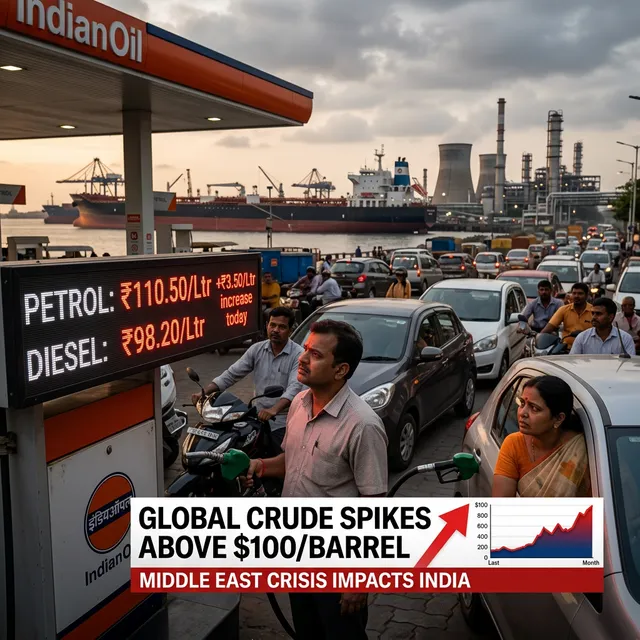
When tensions escalate in the Middle East, my first thought isn't geopolitics—it's petrol prices. This is not an admission of intellectual shallowness; it is an accurate reflection of the economic reality facing 1.4 billion Indians whose daily lives are materially, measurably, and often painfully affected by events occurring 3,000 kilometers away in a region most Indians will never visit. India imports over 85% of its crude oil, and roughly 60% of those imports originate from Middle Eastern countries—Saudi Arabia, Iraq, the UAE, Kuwait, Qatar. The Persian Gulf is not an abstract geopolitical concept for India; it is the pipeline through which the energy that powers India's economy flows, and every disruption to that pipeline—whether from military conflict, diplomatic tension, or strategic posturing—transmits economic shockwaves through India's fuel prices, inflation indices, fiscal accounts, current account balance, and ultimately, the household budgets of ordinary Indians buying groceries, commuting to work, and running small businesses.
The relationship between Middle East instability and the Indian economy is neither simple nor intuitive. It operates through multiple, simultaneous transmission channels—crude oil prices, remittance flows, trade relationships, investment patterns, and strategic diplomacy—each with its own dynamics, time horizons, and policy implications. Understanding these channels, their interactions, and their relative magnitudes is essential for any Indian citizen, investor, business owner, or policymaker grappling with the question of how distant conflicts affect domestic prosperity.
The Oil Price Channel: India's Most Acute Vulnerability

India consumed approximately 5.5 million barrels of crude oil per day in 2025-26—making it the world's third-largest oil consumer after the United States and China. Of this consumption, domestic production accounts for roughly 600,000-700,000 barrels per day. The remaining 4.8-5.0 million barrels per day must be imported, at a cost that fluctuates with global crude oil prices—a variable over which India has essentially zero control. When crude oil prices rise from $70 to $90 per barrel (a 28% increase), India's annual oil import bill increases by approximately $25-30 billion—a sum equivalent to the entire annual budget allocation for the National Rural Employment Guarantee Scheme (MGNREGA) or roughly half the annual defence budget.
The transmission from crude oil prices to Indian consumer prices is not instantaneous but it is relentless. Indian retail fuel prices (petrol and diesel) are nominally deregulated—meaning Oil Marketing Companies (Indian Oil Corporation, Bharat Petroleum, Hindustan Petroleum) theoretically adjust retail prices daily based on international crude oil movements. In practice, fuel price adjustments are heavily influenced by political considerations—price increases are delayed before elections and sometimes absorbed by the OMCs as losses, which then require government subsidy compensation, which increases the fiscal deficit, which constrains government spending on infrastructure and social programs. The entire chain—from a drone attack on a Saudi oil facility to the price of auto-rickshaw rides in Pune—takes weeks to months to fully transmit, but the economic logic is ironclad.
Diesel price increases have particularly vicious downstream effects in India because diesel is not merely an automotive fuel—it is the energy source that powers the majority of India's goods transportation. Approximately 70% of Indian freight moves by road, predominantly in diesel-powered trucks. When diesel prices increase, transportation costs increase, which increases the delivered cost of every physical good—food grains, vegetables, construction materials, manufactured products—creating inflationary pressure that extends far beyond the fuel sector itself. The Reserve Bank of India has estimated that a $10-per-barrel increase in crude oil prices adds approximately 30-40 basis points to headline consumer price inflation—a seemingly modest number that, applied to 1.4 billion consumers, represents an enormous aggregate reduction in purchasing power.
The Remittance Lifeline: When Gulf Economies Slow Down
Approximately 8.9 million Indians live and work in the six Gulf Cooperation Council (GCC) countries—Saudi Arabia, UAE, Qatar, Kuwait, Bahrain, and Oman. These workers—ranging from construction labourers and domestic helpers to engineers, doctors, and business executives—collectively remit approximately $35-40 billion annually to India, making the Gulf the single largest source of inward remittances for the Indian economy. India's total inward remittances (approximately $120 billion annually, the highest of any country in the world) constitute a critical macroeconomic variable: they finance the current account deficit, support the rupee's exchange rate, fund household consumption and education in remittance-receiving states, and sustain economic activity in states like Kerala, Telangana, Bihar, and Uttar Pradesh that are heavily dependent on Gulf remittance income.
Middle East instability affects remittances through two channels: direct disruption (workers being evacuated from conflict zones, as occurred during the 2015 Yemen crisis and the 2017 Qatar blockade) and economic slowdown (reduced oil revenue leading to construction project deferrals, layoffs of expatriate workers, and visa restriction tightening). The indirect channel is typically more consequential: when oil prices decline (often a counterintuitive consequence of geopolitical tensions that disrupt demand more than supply), Gulf government revenues contract, infrastructure spending is cut, and expatriate workers face reduced overtime, delayed salary payments, and eventual workforce reductions. India's Operation Vande Bharat—the massive evacuation exercise during the COVID-19 pandemic that repatriated over 4 million Indian nationals from Gulf countries—demonstrated both the scale of India's Gulf diaspora and the logistical complexity of managing its exposure to regional disruption.
The remittance impact is geographically concentrated within India, creating distinct subnational vulnerability profiles. Kerala receives the highest per capita remittance income of any Indian state—an estimated 15-20% of Kerala's state GDP is attributable to Gulf remittances. A sustained disruption to Gulf remittance flows would have catastrophic effects on Kerala's real estate market (substantially funded by Gulf savings), its consumer economy (Gulf remittances fund a significant portion of household consumption and education spending), and its banking system (several cooperative banks have significant exposure to Gulf-dependent borrowers). Telangana, Tamil Nadu, Rajasthan, and Bihar—states with large Gulf worker populations—face analogous but less concentrated vulnerabilities.
The Strategic Petroleum Reserve: India's Insurance Policy
India maintains Strategic Petroleum Reserves (SPR) at three underground rock cavern facilities: Visakhapatnam (1.33 million tonnes), Mangalore (1.5 million tonnes), and Padur (2.5 million tonnes)—a combined storage capacity of approximately 5.33 million tonnes, equivalent to roughly 9-10 days of India's crude oil imports. This reserve exists precisely for the scenario of a severe Middle East supply disruption: if Gulf oil supplies are interrupted by conflict, blockade, or infrastructure destruction, the SPR provides a buffer period during which India can seek alternative supply sources and manage the price shock.
The adequacy of India's SPR is a subject of legitimate debate. The International Energy Agency recommends that member countries maintain reserves equivalent to 90 days of net imports. India's current reserves cover approximately 10 days—dramatically below the IEA benchmark and below the reserves maintained by China (approximately 80 days), Japan (approximately 130 days), and the United States (approximately 60 days in the Strategic Petroleum Reserve plus substantial commercial inventories). The government has approved Phase 2 SPR expansion at Chandikhol (Odisha) and Padur (expansion)—projects that would increase total storage to approximately 12 million tonnes (roughly 22 days of imports). While this expansion is strategically important, achieving the 90-day IEA benchmark would require reserves of approximately 45-50 million tonnes—an investment of several hundred billion dollars at current oil prices that represents an enormous fiscal commitment.
India's Diplomatic Tightrope: Balancing Competing Relationships
India's foreign policy response to Middle East tensions operates under extraordinary constraints because India maintains strategically important relationships with virtually every major actor in the region—relationships that are frequently in conflict with each other. India is simultaneously: a major defence partner of Israel (purchasing approximately $1-2 billion in military equipment annually, including missile defence systems, radar technology, and precision munitions); a massive energy customer of Saudi Arabia, Iraq, and the UAE (purchasing oil, gas, and petrochemical products worth $80-100 billion annually); a significant importer of discounted crude oil from Russia (which has its own complex Middle East entanglements); a close diplomatic partner of Iran (with which India shares cultural, linguistic, and historical connections, and with whom India has invested in the strategically important Chabahar port project); and home to the world's third-largest Muslim population (approximately 200 million Indian Muslims whose sentiments regarding Middle East conflicts inform domestic political calculations).
This multi-directional diplomatic positioning requires India to maintain studied ambiguity on Middle East conflicts—supporting humanitarian principles without explicitly condemning specific actors, maintaining communication channels with all parties, and calibrating public statements with extraordinary precision to avoid alienating any critical relationship. India's voting patterns at the United Nations on Middle East resolutions reflect this calibration: India has historically abstained on or voted in favour of resolutions critical of specific Israeli actions while simultaneously deepening strategic cooperation with Israel through defence purchases, technology partnerships, and diplomatic exchanges.
The diplomatic complexity has a direct economic dimension: India's energy security depends on maintaining relationships with Gulf oil producers, its defence modernization depends partly on Israeli technology, its connectivity to Central Asia depends on the Chabahar port in Iran, and its domestic political stability requires demonstrating sensitivity to the sentiments of its large Muslim population regarding Middle East developments. Any diplomatic misstep—perceived bias toward one party in a Middle East conflict—risks economic retaliation from the opposing party.
Frequently Asked Questions (FAQs)
How quickly do Middle East tensions affect petrol prices in India?
The transmission is not immediate but operates through a well-defined sequence. First, crude oil futures prices on global exchanges (Brent crude, WTI) react within hours or even minutes of significant geopolitical events—a missile strike, a naval incident, a diplomatic breakdown. These futures prices determine the cost at which Indian Oil Marketing Companies (OMCs) purchase crude oil on international markets. However, OMCs purchase crude oil on contracts with delivery periods of 30-90 days, so the actual cost increase to Indian refiners materializes weeks after the futures price spike. Retail fuel price adjustments in India, which theoretically occur daily based on a 15-day rolling average of international prices, may be further delayed by political considerations—particularly before elections. The full transmission from a Middle East event to the Indian pump price typically takes 4-8 weeks, though severe disruptions can trigger emergency price adjustments within days.
Can India reduce its dependence on Middle Eastern oil?
India has been actively diversifying its crude oil import sources. Russia has become a significant supplier (increasing from less than 2% of Indian oil imports before 2022 to approximately 35-40% in 2025-26, driven by discounted pricing following Western sanctions). The United States, Guyana, Brazil, and West African producers are alternative sources. However, complete elimination of Middle Eastern oil dependence is neither feasible nor necessarily desirable: Gulf crude oil grades (particularly Arab Light from Saudi Arabia and Basra Light from Iraq) are specifically suited to Indian refinery configurations, which are optimized for processing medium-sour crude. Swapping entirely to non-Gulf sources would require significant refinery reconfiguration investment. The realistic strategy is diversification—reducing the percentage of imports from any single source—rather than elimination of Gulf dependency.
How does Middle East instability affect India's stock market?
The Indian equity market's sensitivity to Middle East events operates primarily through three channels: crude oil price expectations (higher oil prices compress profit margins for oil-consuming industries and increase inflation expectations, both negative for equity valuations); foreign institutional investor (FII) risk appetite (geopolitical uncertainty triggers "risk-off" behaviour where FIIs reduce emerging market exposure, including India); and sectoral impact (oil marketing companies, airlines, and paint manufacturers—all heavy oil consumers—typically decline, while oil exploration companies like ONGC and Oil India may benefit from higher crude prices). Historically, the market impact of Middle East events has been sharp but short-lived: the initial reaction (typically a 1-3% decline over 2-5 days) is usually reversed within weeks as the market assesses the actual supply disruption—which is typically less severe than initial fears suggest.



Comments (0)
Be the first to share your thoughts on this article.