The conversation about AI and employment has been conducted primarily in the register of panic—breathless headlines about millions of jobs being "destroyed," "eliminated," or "made obsolete" by artificial intelligence. This framing is not merely unhelpful; it is actively misleading because it treats employment as a binary state (you have a job or you don't) rather than as a dynamic relationship between human capabilities and economic demands that is constantly being renegotiated by technology. The history of work is the history of this renegotiation: the agricultural revolution displaced subsistence farmers and created manufacturing workers; the industrial revolution displaced artisan craftsmen and created factory operators; the computing revolution displaced typists and filing clerks and created knowledge workers. Each transition was wrenching for the individuals who experienced displacement, genuinely beneficial for the economy as a whole, and fundamentally misunderstood at the time by both optimists and pessimists.
The AI employment transition is following this historical pattern with one critically important difference: speed. Previous technology-driven employment transitions occurred over decades, allowing the labour market to adapt through generational turnover—workers displaced from agriculture retired, and their children entered manufacturing; workers displaced from manufacturing retired, and their children entered services. The AI transition is occurring within individual careers, requiring working adults to acquire fundamentally new skills midlife, without the luxury of generational transition time. This acceleration is not a theoretical concern; it is the central practical challenge that distinguishes the AI employment transition from all previous ones, and it is the challenge that policy, education, and individual career strategy must most urgently address.
What AI Is Actually Automating (Not What You Think)
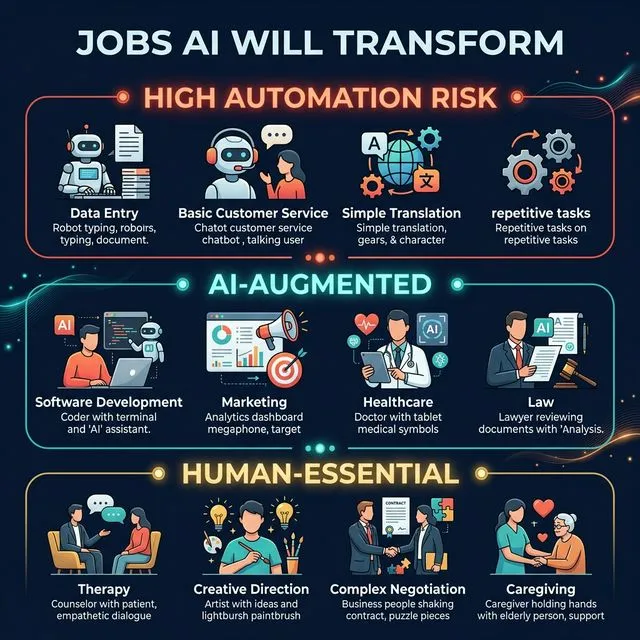
The popular mental model of AI automation—robots replacing factory workers, chatbots replacing customer service agents—captures a small fraction of the actual displacement pattern. The more consequential automation is happening in knowledge work: the administrative, analytical, and communicative tasks that constitute the daily work of lawyers, accountants, marketers, analysts, project managers, and other white-collar professionals. A McKinsey Global Institute analysis estimated that approximately 60-70% of current work activities could be technically automated using existing AI technology—not 60-70% of jobs (a crucial distinction), but 60-70% of the individual tasks within jobs. The implication is that most jobs will not be eliminated but fundamentally restructured: the specific tasks within the job will change, the skills required to perform the job effectively will shift, and the value that the human worker contributes will be concentrated in the tasks that remain after automation.
Consider the legal profession. A junior associate at a law firm traditionally spends enormous amounts of time on document review—reading thousands of pages of contracts, discovery documents, regulatory filings to identify relevant clauses, provisions, and potential issues. AI-powered legal review tools can now perform this document analysis at a fraction of the time and cost, with comparable or superior accuracy for pattern-matching tasks. This does not eliminate the junior associate's job—it eliminates the document review component of the job, which typically consumed 30-50% of their working hours. The hours freed up must be filled with higher-value work: legal strategy, client communication, creative problem-solving, courtroom advocacy—tasks that require human judgment, persuasion, and the ability to navigate ambiguity in ways that AI cannot replicate. The junior associate who adapts to this new task composition—developing strengths in the human-exclusive capabilities while leveraging AI for research and analysis—becomes more valuable. The junior associate who defined their professional identity through document review volume is displaced.
This pattern—AI automating the routine and analytical components of jobs, concentrating human value in the creative, interpersonal, and judgmental components—repeats across virtually every knowledge-work domain. Marketing analysts spend less time compiling data and more time interpreting insights. Financial advisors spend less time running portfolio calculations and more time understanding client circumstances and communicating recommendations. Journalists spend less time on factual research and more time on investigation, source development, and narrative craft. In each case, the job persists but its composition changes, and the skills that determine professional success shift accordingly.
The Skills That Actually Matter Now
If AI is automating routine cognitive tasks—data analysis, pattern recognition, content generation, scheduling, information retrieval—then the skills that retain and increase their value are the ones that AI cannot replicate. These are not, as often claimed, exclusively "creative" or "emotional" skills. They are more precisely described as skills involving:
Ambiguity Navigation: The ability to function effectively in situations where the problem is not clearly defined, the relevant information is incomplete or contradictory, the stakeholders have conflicting interests, and the "right" answer does not exist in any objective sense. AI excels in well-defined problem spaces with clear success criteria; it struggles in genuinely ambiguous situations that require judgment calls, risk tolerance assessment, and the balancing of incommensurable values. Leadership, entrepreneurship, negotiation, strategic planning, and crisis management all involve navigating ambiguity of this kind.
Relational Intelligence: The ability to build trust, read emotional subtext, motivate team members, manage conflict, and navigate the complex social dynamics of organisations and client relationships. These capabilities depend on empathy—the ability to model another person's mental and emotional state—and on physical presence, body language, and the subtle interpersonal signals that constitute the majority of human communication. AI can simulate empathetic responses textually, but it cannot genuinely model another person's emotional state or respond adaptively to the non-verbal cues that dominate face-to-face interaction.
Cross-Domain Synthesis: The ability to draw connections between disparate fields, apply insights from one domain to problems in another, and generate solutions that emerge from the intersection of different knowledge areas. AI operates within the boundaries of its training data and the patterns it has extracted from that data. Human experts who deeply understand multiple domains can generate insights that combine those domains in genuinely novel ways—applying biological principles to engineering problems (biomimicry), using game theory in medical decision-making, or connecting historical patterns to contemporary strategic challenges.
The Indian Employment Landscape: Unique Challenges
India's employment situation introduces variables that make the AI job transition uniquely consequential. India's workforce of approximately 500 million people includes roughly 90% in the informal sector—agriculture, small manufacturing, construction, domestic work, street vending—where AI automation is largely irrelevant because these jobs involve physical tasks in unstructured environments that current AI and robotics cannot address. The remaining 10%—approximately 50 million formal sector workers—are concentrated in precisely the industries most susceptible to AI-driven task restructuring: IT services (5+ million workers), business process outsourcing (3+ million), banking and financial services (5+ million), and professional services.
India's IT services industry—the crown jewel of India's post-liberalisation economic success—faces the most direct AI challenge. The industry's business model is fundamentally based on providing skilled human labour at lower cost than clients' domestic alternatives. AI tools that automate coding, testing, documentation, and system administration directly compete with this human-labour-as-a-service model. The major Indian IT companies (TCS, Infosys, Wipro, HCL) have publicly acknowledged this challenge and are investing heavily in AI-enabled services—transforming from "body shops" (billing for engineer hours) to "solution providers" (billing for outcomes delivered using AI-augmented teams). This transition will require fewer, more skilled engineers rather than larger teams of less specialised ones, with profound implications for India's engineering education pipeline and employment absorption capacity.
Frequently Asked Questions (FAQs)
Should I be worried about losing my job to AI?
"Worried" is the wrong emotion; "strategically aware" is the right one. Instead of generalised anxiety, conduct a specific analysis: list the tasks that constitute your daily work, estimate which of those tasks AI could perform adequately (data compilation, routine writing, scheduling, pattern-matching analysis), and assess what percentage of your professional value comes from AI-automatable tasks versus uniquely human tasks (relationship management, strategic judgment, creative problem-solving, physical skills). If the majority of your value comes from automatable tasks, you need to actively develop the skills in the non-automatable categories. If your value is already concentrated in human-exclusive capabilities, AI is more likely to augment your productivity than threaten your employment. The critical action is not worrying but auditing your skill portfolio against AI capabilities and investing in the gaps.
What should I study or learn to be "AI-proof"?
No career is permanently AI-proof—the technology's capabilities are expanding continuously, and predictions about what AI will or will not be able to do in ten years are unreliable. However, the skills with the longest estimated time-to-automation are: complex physical skills in unstructured environments (skilled trades, surgery, emergency response), creative and strategic thinking (entrepreneurship, design leadership, research), interpersonal and emotional skills (therapy, coaching, teaching, nursing, leadership), and domain expertise combined with judgment (experienced professionals in any field whose value comes from pattern recognition developed through years of practice). The meta-skill that matters most is adaptability itself: the capacity to learn new skills continuously, to pivot your professional identity as circumstances change, and to treat your career as a portfolio of capabilities rather than a fixed job title.
Will AI create new jobs that don't exist yet?
Yes—history demonstrates that technology transitions consistently create more jobs than they destroy, though the new jobs are typically different in nature, location, and skill requirements from the displaced ones. AI has already created new job categories that did not exist five years ago: prompt engineers, AI ethics officers, machine learning operations engineers, AI trainers (humans who provide feedback data to train AI systems), and AI-augmented specialists in every domain (AI-assisted diagnosticians, AI-enhanced financial analysts, AI-powered creative directors). The challenge is not job creation but job transition: the new jobs require different skills than the old ones, and the workers displaced from old roles may not have the training, location, or resources to fill the new roles. Managing this transition—through reskilling programs, education reform, social safety nets, and geographic mobility support—is the central policy challenge of the AI employment era.



Comments (0)
Be the first to share your thoughts on this article.